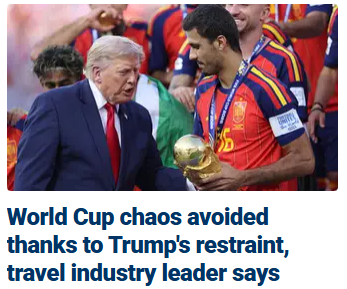
The successful staging of the 2026 FIFA World Cup was due not only to measures taken by President Donald Trump’s administration to streamline visa processing, strengthen security, and improve airport operations for international visitors, but also to several policies the administration deliberately chose not to implement, according to the head of the U.S. Travel Association.
In a letter to President Trump obtained by Fox News Digital, U.S. Travel Association President and CEO Geoff Freeman praised the administration for avoiding a number of proposed travel restrictions in the months leading up to and during the tournament. He argued that those decisions played a major role in ensuring the World Cup became a “resounding success.”
Freeman noted that faster visa appointment processing, combined with the strong performance of the Visa Waiver Program (VWP) and the Electronic System for Travel Authorization (ESTA), allowed the United States to handle unprecedented demand without compromising security. According to the letter, the programs processed more than five million applications and approvals while maintaining high security standards.
“Just as significant,” Freeman wrote, “were the actions your administration chose not to take before and during the World Cup,” emphasizing that refraining from implementing certain travel-related policies helped prevent unnecessary disruptions for millions of visitors.
The U.S. Travel Association, one of the travel industry’s most influential advocacy organizations in Washington, represents more than 1,000 businesses and organizations across the travel sector. The nonprofit describes itself as the leading voice for an industry valued at approximately $2.9 trillion and advocates on issues such as visa policy, airport operations, travel security, and international tourism. Freeman’s remarks carry added significance as the United States prepares to host several major global events, including the Summer Olympics, Winter Olympics, and the FIFA Women’s World Cup.

France supporters celebrate after their team’s victory over Sweden during a 2026 FIFA World Cup match in Brooklyn, New York City, on June 30, 2026. (Photo by Leonardo Munoz/AFP via Getty Images)
Freeman’s letter, supported by research from the U.S. Travel Association and Morning Consult, portrays the 2026 World Cup as both a tourism success and a public diplomacy achievement that generated benefits well beyond the host stadiums and cities.
According to Freeman, more than 80% of international World Cup visitors expressed interest in traveling outside the tournament’s host cities, suggesting the event encouraged broader tourism across the United States. The accompanying survey also found that 81% of Americans said seeing international visitors enjoy the country’s food, culture, and attractions made them proud to be American, while 86% said they felt genuine happiness watching tourists have a positive experience.
Freeman argued that the warm reception extended to visitors throughout the tournament represented more than an act of hospitality. He described it as an investment in both the U.S. economy and the nation’s global reputation.
The letter also highlighted the World Cup as a model for hosting future international events. Survey results showed that 70% of Americans support bringing more major global competitions and exhibitions to the United States, including the Olympic Games, the FIFA World Cup, and the World’s Fair. Looking ahead, the U.S. is scheduled to host the 2028 Summer Olympics, the 2031 FIFA Women’s World Cup, and the 2034 Winter Olympics.

Egyptian and Argentine fans celebrate after Egypt scored during a FIFA World Cup Round of 16 watch party at Cerveceria La Tropica in Miami, Florida, on July 7, 2026. Argentina and Egypt faced off in the Round of 16 in Atlanta. (Photo by Joe Raedle/Getty Images)
Freeman also commended the Trump administration for choosing not to implement several proposed travel policies ahead of the World Cup, arguing that those decisions helped ensure a smoother experience for international visitors.
Among the measures he highlighted were delaying the introduction of the $250 Visa Integrity Fee, shelving proposals that would have reduced the presence of U.S. Customs and Border Protection (CBP) officers at certain airports, and postponing new travel authorization requirements for visitors entering under the Visa Waiver Program (VWP).
According to Freeman, holding off on the $250 Visa Integrity Fee allowed travelers from countries such as Argentina to spend more money at American businesses, from major retailers like Buc-ee’s to locally owned barbecue restaurants, rather than paying additional government fees.
He also noted that by maintaining CBP staffing levels at key airports, the administration helped ensure efficient screening and entry procedures for returning Americans as well as foreign fans, athletes, and tournament personnel arriving in the United States.
Freeman further argued that postponing new Electronic System for Travel Authorization (ESTA) requirements enabled Visa Waiver Program visitors—including Scotland’s famous “Tartan Army” supporters—to travel to the United States in record numbers. He said the visitors still underwent rigorous security screening and later shared positive experiences across social media, praising the country’s hospitality and the overall World Cup experience.

President Donald Trump stands alongside the FIFA World Cup Trophy as FIFA President Gianni Infantino speaks during a FIFA reception at Trump Tower in New York. (Mandel Ngan/AFP via Getty Images)
A data memo accompanying Freeman’s letter emphasized that the travel policies left unimplemented were viewed by the U.S. Travel Association as more than routine administrative decisions, arguing they played a meaningful role in shaping visitors’ experiences during the tournament.
According to the survey, four out of five Americans believe it is important for international visitors to enjoy a positive experience while traveling in the United States. The findings also showed that 61% of respondents believe tourism enhances America’s reputation abroad, while half said that visiting the country provides foreigners with a more accurate understanding of American culture than news outlets, social media, or other online sources.
Responding to the report, White House spokesperson Davis Ingle credited President Donald Trump with the successful execution of the 2026 FIFA World Cup.
“No other president in history could have achieved what President Trump accomplished for both the American people and the global community,” Ingle told Fox News Digital. He said the administration’s leadership helped the tournament generate billions of dollars in economic activity, deliver a major financial boost to host cities, and provide a safe, secure, and efficient experience for millions of fans, athletes, and visitors from around the world. Ingle added that the 2026 FIFA World Cup would be remembered as one of the largest and most successful sporting events ever held.