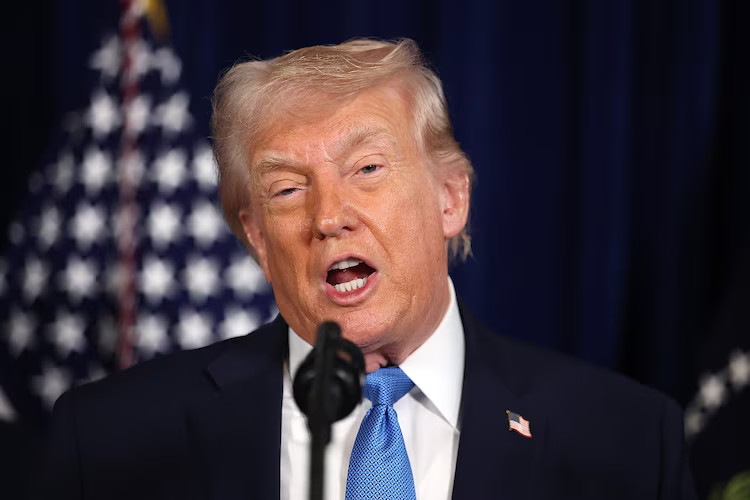
LONDON — President Donald Trump intensified his confrontational stance toward leftist leaders in Latin America on Sunday, strongly implying that Colombian President Gustavo Petro could soon face U.S. intervention while suggesting Cuba’s communist government is on the verge of falling without Venezuelan support.
Speaking to reporters, Trump described Colombia as “very sick too, run by a sick man who likes making cocaine and selling it to the United States.” He added emphatically, “And he’s not going to be doing it very long, let me tell you.”
When pressed on whether this signaled a potential U.S. military operation against Colombia — similar to the weekend raid that captured ousted Venezuelan leader Nicolás Maduro — Trump replied, “It sounds good to me.”
The remarks come amid escalating regional tensions following Saturday’s U.S. operation in Venezuela, which seized Maduro and his wife for trial on narco-terrorism charges.
Colombian President Petro swiftly rejected the accusations in a public statement, declaring, “I deeply reject Trump speaking without knowing; my name does not appear in the judicial files on drug trafficking over 50 years, neither from before nor from the present.”
He continued: “Stop slandering me, Mr. Trump. That’s not how you threaten a Latin American president who emerged from the armed struggle and then from the people’s struggle for Peace in Colombia.”
On Cuba — a staunch ally of the Maduro regime that lost at least 32 personnel defending him during the raid — Trump suggested the island’s government had relied heavily on Venezuelan financial aid.
“Now, they won’t have that money coming in. They won’t have the income coming in,” Trump said, noting that many of the Cubans killed in the operation “were trying to protect Maduro.”
The president’s comments signal a potential broadening of U.S. assertiveness in the Western Hemisphere, raising concerns about further interventions in the region.

“Cuba looks like it’s ready to fall. I don’t know how they — if they’re going to hold out, but Cuba now has no income,” Trump told reporters. “They got all of their income from Venezuela, from the Venezuelan oil. They’re not getting any of it. And Cuba literally is ready to fall. And you have a lot of great Cuban Americans that are going to be very happy about this.”
When pressed again on whether the U.S. is contemplating military action in Cuba similar to the weekend operation in Venezuela, Trump dismissed the need: “It looks like it’s going down.”
The comments come as Cuba mourns the loss of 32 military and security personnel killed defending Maduro during Saturday’s U.S. raid, and as regional allies reel from the rapid fall of the Maduro regime.
In Venezuela, the Supreme Court has appointed Vice President Delcy Rodríguez as interim president, officially describing the U.S. operation as a “kidnapping.” Rodríguez, who initially demanded Maduro’s immediate return and vowed to resist “American aggression,” has since signaled openness to cooperation with the Trump administration.
Maduro and his wife, Cilia Flores, are scheduled for their initial court appearances Monday in Manhattan federal court on narco-terrorism and drug trafficking charges.

Venezuela’s newly appointed interim President Delcy Rodríguez shifted to a conciliatory tone Sunday, posting a statement on social media inviting the United States to “collaborate with us on an agenda of cooperation oriented towards shared development within the framework of international law to strengthen lasting community coexistence.”
The overture marks a notable softening from Rodríguez’s initial demands over the weekend for the immediate return of captured former leader Nicolás Maduro, whom she described as the victim of a U.S. “kidnapping.”
Meanwhile, President Donald Trump maintained a hardline stance, telling reporters Sunday that the U.S. is now “in charge” of Venezuela. He demanded that Rodríguez grant “total access” to the country’s vast oil reserves, warning of further action if she fails to “do what’s right.”
In remarks to The Atlantic, Trump reiterated the need for unrestricted access to Venezuelan oil fields. He confirmed he has not yet spoken directly with Rodríguez but added, “At the right time, I will.”
The exchange highlights ongoing tensions and potential negotiations following Saturday’s U.S. military operation that seized Maduro and his wife for trial on narco-terrorism charges in New York.