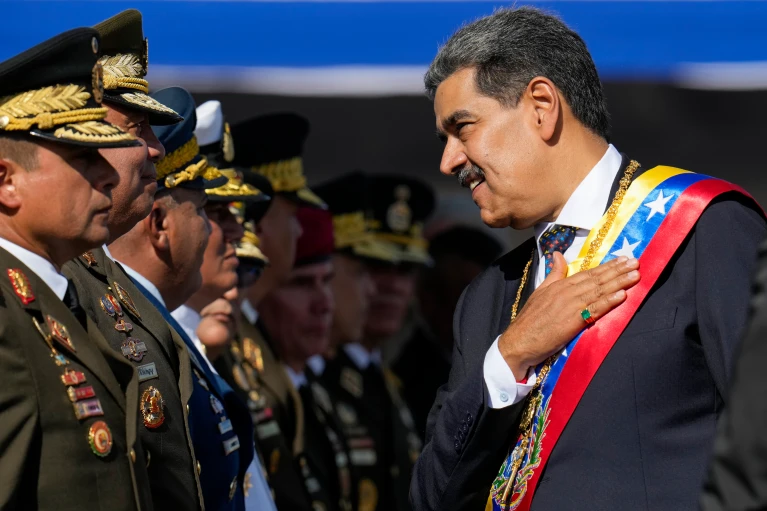
NEW YORK — Nicolás Maduro, the former president of Venezuela captured in a U.S. military operation over the weekend, appeared in a Manhattan federal courtroom on Monday for his initial arraignment on long-standing narco-terrorism and drug trafficking charges.
Dressed in a blue prison jumpsuit, Maduro and his wife, Cilia Flores, were escorted into the courthouse shortly after noon for the procedural hearing. Both wore headsets to follow the proceedings, which were translated into Spanish. The couple had been flown from a Brooklyn detention facility under heavy security, arriving via a swift motorcade and helicopter transfer across New York Harbor.
Maduro, who appeared to walk with a limp, was transported from the Metropolitan Detention Center early Monday morning. The operation mirrored high-security protocols, landing at a Manhattan heliport before proceeding to the federal courthouse — the same complex where former President Donald Trump was convicted in 2024 on unrelated charges.
Outside the building, police managed small crowds of protesters opposing the U.S. intervention and a handful of supporters decrying it. One demonstrator attempted to seize a Venezuelan flag from the opposing group.
As a defendant in the U.S. justice system, Maduro is entitled to the same rights as any accused individual, including a jury trial. However, his case is extraordinary: His legal team is anticipated to challenge the arrest’s legality, citing head-of-state immunity — a defense unsuccessfully used by Panama’s Manuel Noriega after his 1990 capture by U.S. forces.
The U.S. does not recognize Maduro as Venezuela’s legitimate leader, especially following the disputed 2024 election. A superseding indictment unsealed over the weekend accuses Maduro, his wife, and others of conspiring to flood the U.S. with thousands of tons of cocaine in partnership with cartels and gangs like Tren de Aragua. Charges include narco-terrorism conspiracy, cocaine importation, and weapons offenses, potentially carrying life sentences.
Maduro has long denied involvement in drug trafficking, previously attributing U.S. actions to desires for Venezuela’s vast oil reserves. Interim President Delcy Rodríguez, appointed by Venezuela’s Supreme Court following Maduro’s removal, has demanded his return while adopting a more conciliatory tone, expressing willingness for “respectful relations” and collaboration with the Trump administration.
President Trump has stated the U.S. will temporarily oversee aspects of Venezuela’s affairs, particularly enforcing an oil “quarantine” on sanctioned exports, though Secretary of State Marco Rubio clarified this does not entail day-to-day governance. Trump has also issued warnings to neighboring leaders and suggested broader assertions of U.S. influence in the region.
Oil prices edged up slightly Monday amid uncertainties over Venezuela’s production ramp-up after years of underinvestment.
It remains unclear if Maduro has retained U.S. counsel, complicated by longstanding sanctions barring Americans from financial dealings with him or his wife without Treasury approval.
The indictment also names Maduro’s son (who remains at large), former ministers, and alleged gang leaders, accusing the group of orchestrating kidnappings, beatings, and murders tied to their operations. Flores faces additional bribery allegations from years prior.
Reporting contributed from Washington and Miami.